

Whether you’re stuck riding in a smaller arena due to winter weather, need to get out of a riding rut or are looking for a new exercise to put your aids to the test, consider adding the “Circle of Death” to your training routine. The exercise got its menacing name due to the fact that it forces you to ride every single step to navigate it successfully and therefore requires just as much skill in the saddle as it does brain power.
Hunter/jumper trainer Rachel Rohweder, who owns and operates Native River Farms in Princeton, Texas, regularly challenges her students with this difficult exercise to teach them how to more effectively use their outside aids, make squarer turns and improve their horses’ adjustability.
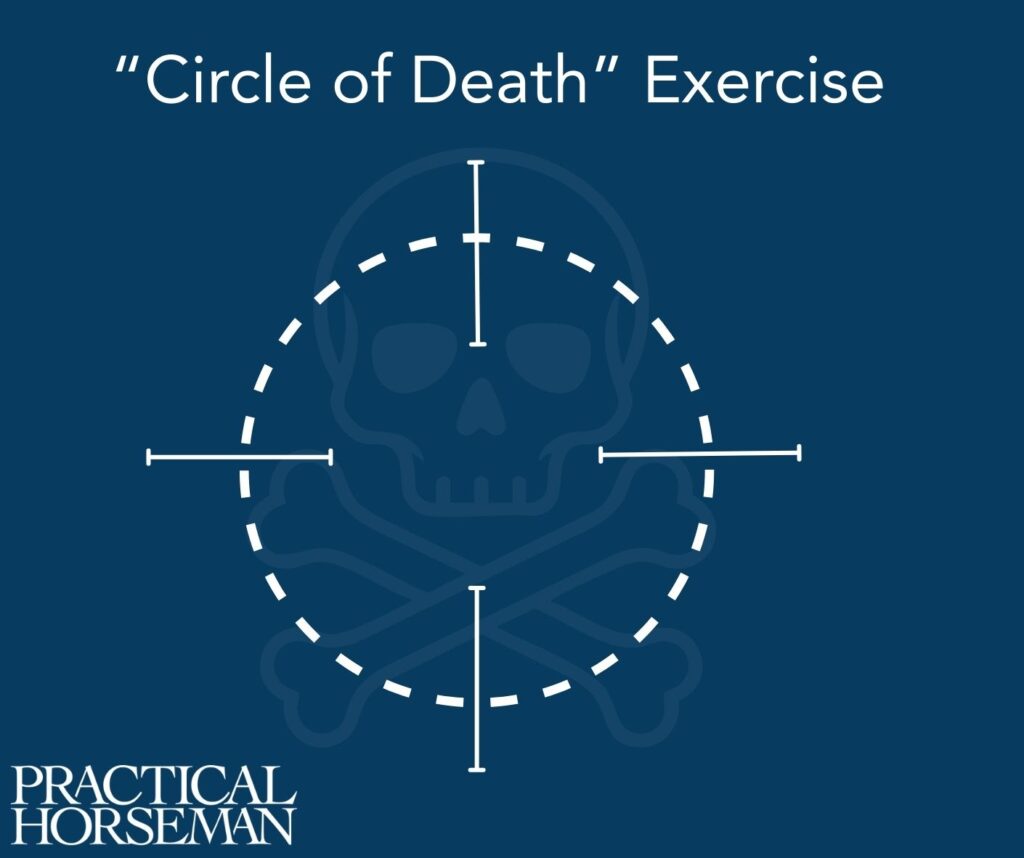
This exercise will also help improve your balance, rhythm, stride control and accuracy for jumping because it demands that you keenly focus on your aids to find the correct number of strides between the cavalletti. Plus, it will help you better understand how your track affects distances and strides and can help horses who tend to rush by encouraging them to maintain a consistent rhythm.
Use Rohweder’s tips to successfully conquer the notorious Circle of Death.
Setup
This exercise involves a simple setup of four cavalletti on a circle. You can think about setting it up as an approximate 20-meter circle, but the size will also depend on the shape and size of your arena. Rohweder likes to set the distances between cavalletti slightly on the half-step between four and five strides to teach her students how to adjust their pace and track to get a varying number of strides between each. (For more on how to walk distances, use these helpful insights from show jumper Ronny Reimer.)
Caveat: If you’re a beginner or lower-level intermediate rider, this exercise should only be done under the supervision of your trainer or a professional.
Breaking the Circle Down
After thoroughly warming up on the flat and ensuring your horse is listening and on the aids, Rohweder suggests warming up to the exercise by first cantering only cavalletti 1 and 3 off the left lead and then reversing it by cantering cavalletti 3 to 1 off the right lead. In both directions, focus on using your outside aids to keep your horse straight to the first cavalletti and as you turn to the second, ensure you “close the door” with your outside leg to maintain that straightness.
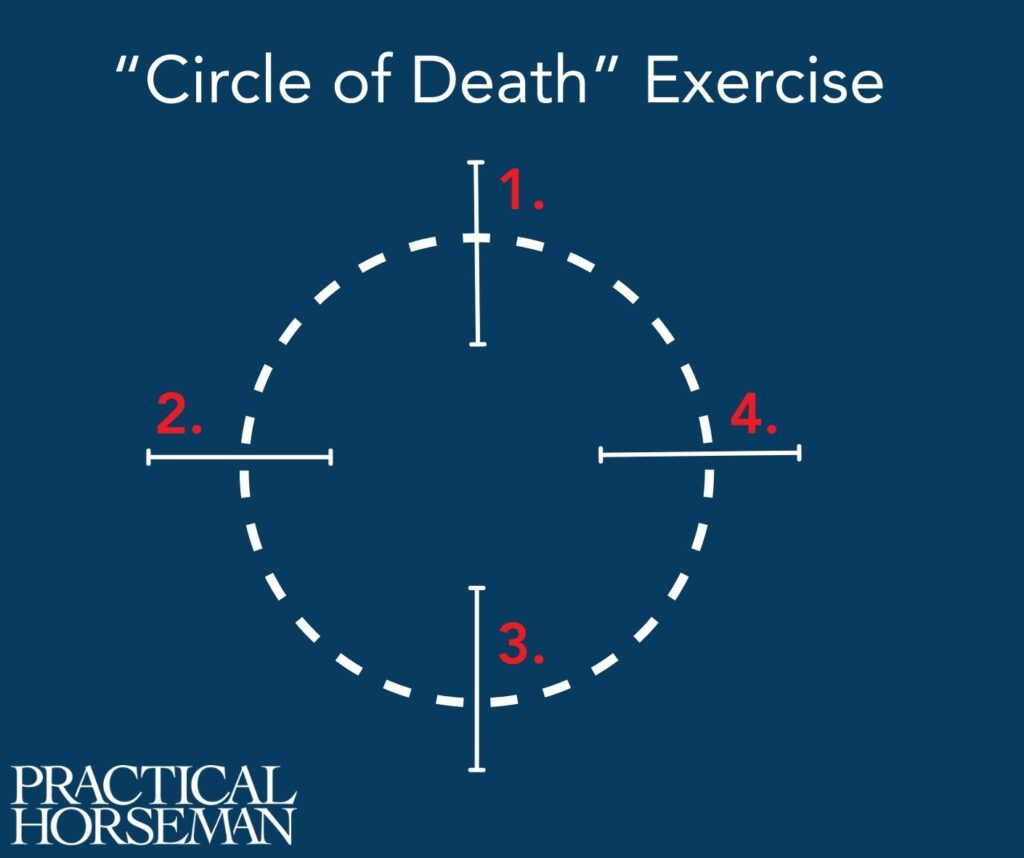
Next, she advises cantering cavalletti 2 to 4 off the left lead and 4 to 2 off the right to help you get a feel for putting the entire circle together. You might find that one part of the circle rides differently than the other.
Putting the Circle of Death Together
Now that you’ve gotten a feel for how all four cavalletti will ride off both the left and right leads, it’s time to put the circle together. Starting off the left lead over cavalletti 1, Rohweder first has her students ride the circle in a more collected canter for five strides in between the cavalletti. With this in mind, she encourages riders to establish an uphill canter going in and to maintain rein contact to half-halt as needed.
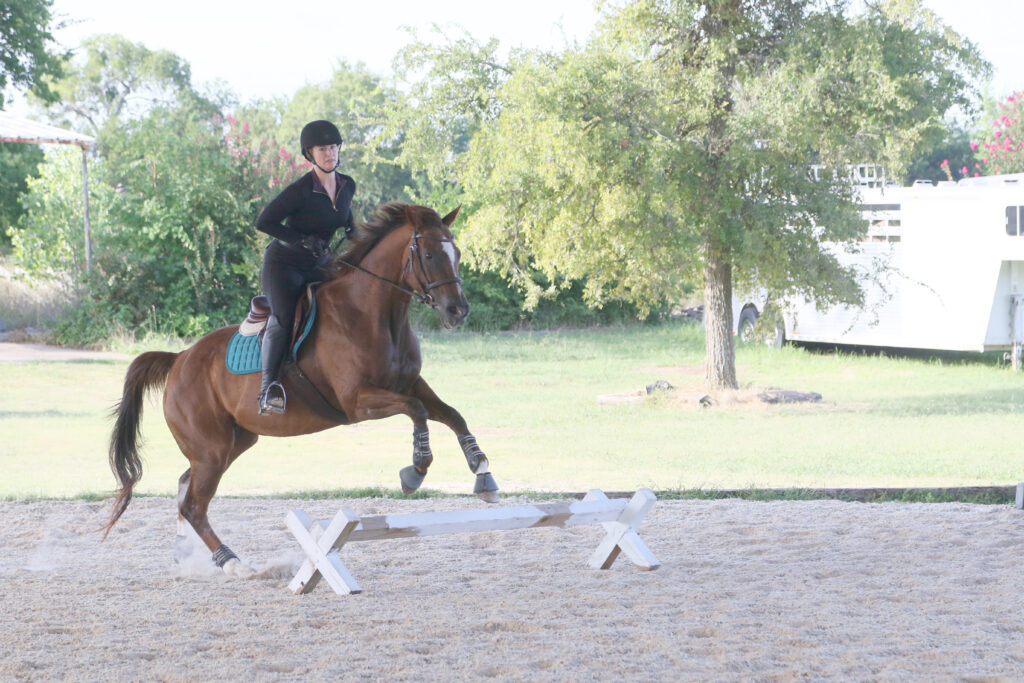
Before cavalletti 1, be prepared to immediately direct your horse to cavalletti 2, by slightly looking left toward the next part of the circle and preparing to close your outside leg to keep you horse on the track. If you use too much inside rein to turn you’ll pull your horse off the track and prevent him from staying straight and balanced. Don’t get discouraged if it takes you a few times to get through the circle. It may require a few tries to get a feel for how much rein and leg you need, but Rohweder constantly stresses that if you use rein it must be backed up by your leg.
If your horse naturally has a longer stride, you may need to take the outside track to make the striding work for the five. And if you find yourself getting too preoccupied with the distances, simply think about cantering a nice, rhythmic 20-meter circle that happens to have four little cavalletti in the way.
Once you’ve mastered the five strides off the left, reverse and try it off the right, so you’ll start with cavalletti 3 and work the circle in the opposite direction. Keep in mind that you might have to adjust your aids in the different direction since most horses have a favorite, more supple way of going and might not be as straight or adjustable in the other direction.
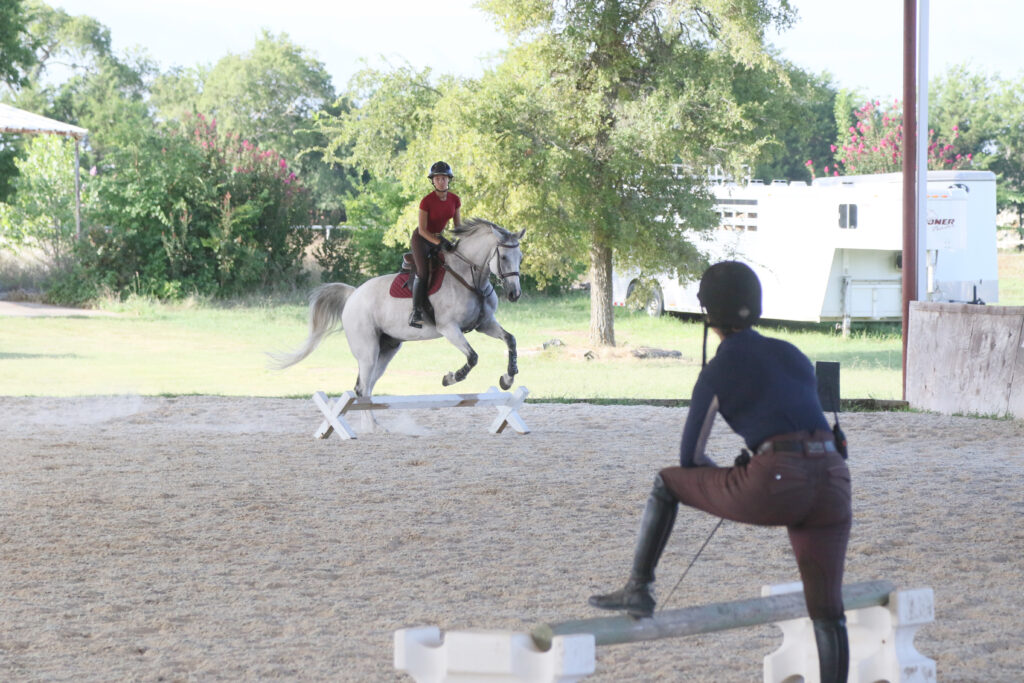
Next, Rohweder tasks her students with riding the exercise in four strides, stressing that while you want to open your horse’s stride a bit for the four, you do not want a running, flat canter where your horse hollows his back and falls on his forehand. You still want to maintain that uphill feeling while lengthening the stride. After doing the exercise in five strides, the four strides is going to feel quick, so it’s even more important that you’re on your aids, looking where you’re going and riding every stride.
As you advance and your horse’s adjustability improves, challenge yourself even further by changing up the number of strides between cavalletti. For example, you could do five strides from cavalletti 1 to 2, four strides between 2 to 3, five strides between 3 to 4 and four strides from 4 back to 1.
We hope these tips help you tackle the Circle of Death—and come out a better rider after nailing it!
About Rachel Rohweder
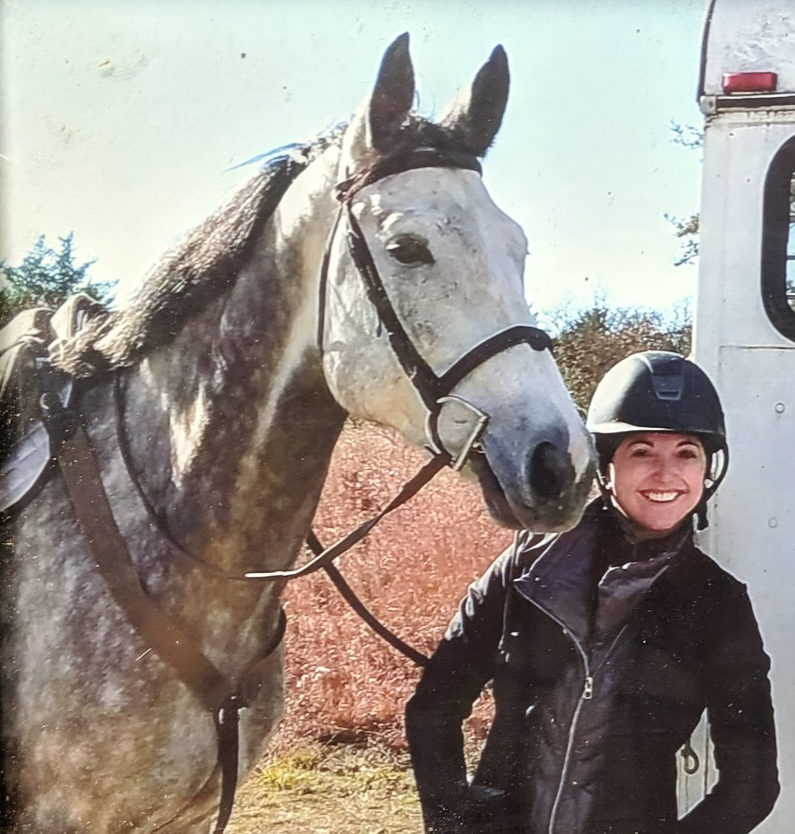
With more than 17 years of competitive riding experience ranging from young to nationally ranked horses, Rachel Rohweder aims to help both horse and rider achieve their goals in her Native River Farms program in Princeton, Texas. With her background competing in the hunter, jumper and equitation arenas as a foundation, she focuses on developing young horses and fostering riders of all skill levels.
Rohweder started her equestrian journey in Colorado where she competed as a Junior predominately in the zone 8 region. She excelled at catch-riding and gained extensive experience showing in hunters, derbies, big equitation medals and jumpers, while training with Mark Mead, Laurie Jueneman and Steve Johnson. As a Maclay Finals qualifier in 2010, she has also shown on the East Coast (indoors) and in Wellington, Florida.
Following her Junior career, Rohweder attended Baylor University in Waco and where she received her finance and accounting degree, while also commuting to Flower Mound, Texas, to compete with Woodhill Farms and Matt Cyphert, leading her to settle in Dallas and establish her herself as a professional rider in the Dallas-Fort Worth area.